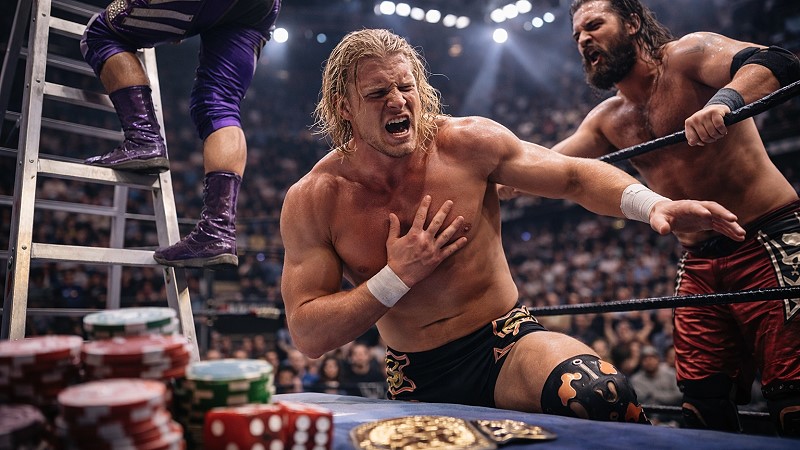
Back in 2012, WWE star AJ Lee was living up her slogan: “love bites.” Unfortunately for John Cena, he found himself at the receiving end of her wrath at that year’s edition of WWE TLC. After skipping around Cena and wooing him with her charisma, Lee ultimately betrayed the “G.O.A.T” by pushing him off a ladder and siding with his rival at the time, Dolph Ziggler. When reminiscing on this pivotal moment with “The Match-Up,” Lee was taken back by how many fans were heartbroken in the crowd, but there was one particular fan that turned his heartbreak into a vitriolic response.
“I can’t use the words because they’re the filthiest words ever,” Lee said of a little boy who couldn’t forgive her for her turn. “I turned on John Cena. Like, pushed him off a ladder, and I will never forget, like, going down the entrance ramp and this dad and a little boy were like, ‘Yay,’ they were so happy to see me, and then I turned on John Cena and I was coming to the back and this little boy, like, said the most foul curse word at me, and then his dad was like, ‘Yeah, that’s right!’ His dad was so proud of him.”
Lee would eventually win the crowd back over not only as champion, but as a general manager. After a decade-long hiatus, Lee returned to WWE in September of 2025. Five months after her shocking comeback, she became the Women’s Intercontinental Champion. Her title run lasted until WrestleMania 42, where she dropped the championship to the woman she originally won it off from, Becky Lynch. As of this report, creative plans to have the former three-time Divas Champion back on television again have come to a halt. There’s no news on when she’ll return.
If you use any of the quotes in this article, please credit “The Match-Up/iHeart Women’s Sports” and provide a h/t to Wrestling Inc. for the transcription.
There are moments in sports entertainment history where the answer is so obvious, it almost feels embarrassing that no one has acted on it yet. A global WWE 2K esports tournament is one of those moments. The ingredients are all sitting right there. A passionate global fanbase? Checked. A video game franchise with decades of momentum? Absolutely. An organisation whose greatest superpower has always been spectacle and marketing? Perfect. So, despite that, why hasn’t it happened at scale?
The Fanbase Is Already There
WWE does not need to build an audience for a 2K esports circuit from scratch. It already exists. The people who tune into Raw and SmackDown every week are, to a significant degree, the same people who spend hours perfecting their reversals and building dream rosters in MyFaction mode. Wrestling fans are not casual about their fandom at all. If anything, they are obsessive, encyclopaedic, and deeply invested in anything connected to the WWE universe. That naturally extends to video games. The WWE 2K community has demonstrated this time and again, from years of self-organised online tournaments to the collective uproar every time a new game disappoints. That is not the behaviour of a disengaged audience. That is exactly the kind of energy esports organisations pay millions to cultivate.
WWE Has Already Tested the Waters
Credit where it is due. WWE has made tentative moves in this direction. The WWE 2K24 Showdown Championship at WrestleMania weekend in Philadelphia drew enthusiastic crowds, with WWE superstars paired with media personalities in a tournament format that clearly resonated. Before that, the WWE 2K Battlegrounds Clash of Countries pitted content creators from seven different countries against one another, hosted by WWE legends Jerry “The King” Lawler and Samoa Joe. WWE superstars have also appeared at the Gamers8 event in Saudi Arabia, described as the world’s largest esports tournament at the time, specifically to promote the 2K franchise. These are not coincidences. They are proof of concept. What they lack is commitment.
The Counterargument Worth Hearing
To be fair, the scepticism about a fully competitive WWE 2K esports scene is not unfounded. The most honest criticism is about depth. Unlike fighting games such as Street Fighter or Tekken, where mechanical complexity rewards years of practice, WWE 2K has historically been designed with accessibility at its core. Appealing to casual players often means streamlining in-ring mechanics, which limits the kind of skill ceiling that competitive esports demands. Critics have pointed out that there is little technical depth in a WWE 2K match compared to traditional esports titles, where the gap between a beginner and an expert is vast and visible. That is a real problem. It is also a solvable one.
Why This Time Could Be Different
WWE 2K26 appears to be taking the gameplay depth criticism seriously. Developers have redesigned the game’s animation and control system, aiming to eliminate the delay lag that plagued prior entries and make matches feel like real, flowing in-ring action. If the overhaul delivers, the mechanical foundation for a genuinely competitive experience becomes credible. Meanwhile, the vast roster of WWE 2K games already offers an opportunity for diverse matchups similar to fighting games, where each character has unique attributes, including different move sets, strengths, and weaknesses. This creates intriguing competitive scenarios where players must choose characters that complement their style or counter their opponent’s choices. Pair that with the storytelling potential, rivalries, heel turns, championship arcs built into the tournament narrative, and WWE 2K actually has something no traditional esports title can offer: drama that feels authentic to its source material.
The Marketing Case Is Obvious
This is where WWE’s unquestionable strength comes in. Nobody in entertainment builds anticipation, sells narratives, and creates cultural moments quite like WWE. WrestleMania is not just a wrestling event, but a weeks-long spectacle. Apply that same promotional engine to a WWE 2K World Championship circuit and the results would be significant. Regional qualifiers streamed on Twitch and YouTube, a grand finals at WrestleMania weekend, superstars involved as commentators and special guests, the blueprint practically writes itself.
The wrestling and gaming audiences are already overlapping. The only thing missing is WWE deciding to fully commit. For fans who want to follow the competitive scene in the meantime, Esport bet covers the broader esports landscape where the real competitive infrastructure already lives, and where WWE 2K could one day earn its place.
The tournament is not a gamble. It is the most logical next move. The question is whether WWE will make it before someone else fills the gap.
Nearly a year after the passing of Hulk Hogan, authorities have officially closed the investigation into his death. Officials determined that Hogan, whose real name was Terry Bollea, died of natural causes and confirmed that no criminal activity was involved.
Despite that ruling, his daughter Brooke Hogan has publicly expressed concerns about how the case was handled and says several questions remain unresolved.
Brooke Hogan questions Hulk Hogan death investigation details
Speaking during an appearance on The Bubba the Love Sponge Show, Brooke detailed her frustrations with the investigation process, particularly pointing to what she described as a lack of communication from the Clearwater Police Department.
She explained that while authorities publicly thanked her for cooperating, she did not feel properly informed about key developments. According to Brooke, obtaining official records proved difficult, and many of her requests for clarification either went unanswered or were only partially addressed.
As she reviewed details surrounding her father’s passing, she said she noticed inconsistencies that raised doubts about the official timeline. Among her concerns was the handling of medical documentation. Brooke questioned why a family physician signed the death certificate rather than a forensic pathologist, and stated she never received the autopsy information she expected.
She also raised questions about toxicology findings, claiming there were unclear explanations regarding blood samples and related records.
“Normally, most autopsies take place within 72 hours of the person dying. So I don’t know how long this information lasts in your eyeball or in your blood or wherever they can pull it from. But they said they didn’t have his blood, but yet they were able to have a toxicology report and they don’t want to list that there was an autopsy on the official record of death on the death certificate. So make that make sense to me,” Brooke said.
Brooke added that she initially believed the family would receive full results over time but said that never happened.
“They played Sky’s 911 tape to me. And at the time, I felt like, ‘Okay, everybody’s cooperating. I feel good. Like, we’ll get the we’ll get the results of the autopsy back.’ But then when the autopsy never came back to me and I kept asking for it, and I kept asking for it, and I kept asking for it, and then it was getting changed. And I asked, ‘Well, what could make a doctor 10 months later make changes to an autopsy?’” she said.
Another issue she highlighted involved surveillance footage from Hogan’s home. Brooke stated that despite a comprehensive camera system, she has not received clear confirmation about whether any footage from the time of his death exists.
She also pointed to conflicting accounts regarding where Hogan was found. According to her, different reports have created confusion about the circumstances.
“My brother told me and my husband, we both heard it, that he died in his chair. Then the report says they found him on the floor. Who found him on the floor? Where were the nurses? Where were they coming back from? Why was Sky the only witness to him not breathing?” Brooke said.
While authorities have closed the case, Brooke Hogan’s comments indicate she is still seeking clarity on several aspects of the investigation.
Brooke Hogan Raises Concerns Following Conclusion of Hulk Hogan Death Investigation
WWE has officially unveiled the promotional poster for Night of Champions 2026, offering fans an early look at the upcoming Premium Live Event set for Saturday, June 27 in Saudi Arabia.
WWE Night Of Champions 2026 poster and event details
The reveal was made by Paul Levesque, WWE’s Chief Content Officer, via social media. Along with the poster, the special start time for the show was also confirmed.
Due to the time difference between the United States and Riyadh, the event will begin at 1 PM Eastern Time and 10 AM Pacific Time. Fans in the United States will be able to watch the show live on Peacock, while international viewers can stream the event on Netflix, with start times varying depending on location.
Night of Champions 2026 will feature talent from both WWE Raw and WWE SmackDown, continuing WWE’s trend of holding major international events in Saudi Arabia.
The stakes for this year’s event are already clear. The finals of both the King and Queen of the Ring tournaments will take place at the show. The winners of those tournaments will earn championship opportunities at SummerSlam 2026, making Night of Champions a key stop on the road to WWE’s biggest event of the summer.
The official poster highlights several top champions, including Rhea Ripley, Liv Morgan, Trick Williams, and Cody Rhodes. While their presence on the poster does not confirm matches, it signals their importance heading into the event.
Morgan, in particular, remains in focus as she continues her run in the Queen of the Ring tournament. After advancing to the semifinals on the June 8 episode of RAW, she now has a path to potentially leave Night of Champions with even greater momentum. If she wins the tournament, she would earn a title shot at SummerSlam, where she could challenge for additional gold.
At this stage, no official matches have been announced for the event. However, with tournament finals and championship implications already confirmed, Night of Champions is set to play a major role in shaping WWE’s landscape heading into SummerSlam.
If you’ve watched professional wrestling for any length of time, you’ll know that the landscape has shifted quite dramatically over the last few years. There was a time, not so long ago, when scripts were being torn up minutes before a show went live. It made being a fan somewhat exhausting; you’d invest in a character only for them to disappear or have their entire personality changed overnight. Since Paul “Triple H” Levesque took the creative helm, things have settled into a much more rhythmic, logical pattern. This shift hasn’t just changed how we watch the show on a Monday or Friday night; it’s fundamentally altered how fans in the UK engage with the product outside of the ring.
We’re seeing a move away from just being passive viewers. Instead, the modern fan is more like a detective or a script analyst. Because the storytelling is now more consistent, it has opened up a fascinating world of narrative forecasting. People are looking at the way a character looks at a belt or the subtle phrasing in a promo to figure out where the story is headed three months down the line. It’s a bit like trying to predict the end of a long-running drama series, only the actors are performing stunts and the ending can change if someone picks up a real-world injury.
The Triple H Era: How Long-Term Storytelling Stabilises Speculation
The biggest change we’ve seen since the transition in leadership is the return of the “long game.” In the previous era, things felt impulsive. Now, there’s a sense that the creative team knows exactly where they want to be by the time WrestleMania rolls around. I’ve noticed that this stability makes it much easier for fans to form coherent theories. When you have a storyline like “The Bloodline,” which has spanned years rather than weeks, every single beat matters.
This long-term approach has essentially stabilised the speculation market. If you know that a certain wrestler is being positioned for a title run, you can track their progress through their win-loss record and their screen time. Triple H seems to value the “slow burn,” which is a godsend for anyone who enjoys the analytical side of the sport. It’s no longer about a sudden, inexplicable twist for the sake of shock value; it’s about a logical progression that rewards people for paying attention.
Many of us have experienced the frustration of a story being dropped without explanation. That happens far less frequently now. Instead, we get “Easter eggs” and subtle nods to wrestling history that suggest a deep level of planning. For the UK audience, which has always had a bit of a penchant for the more technical and storied aspects of wrestling (just look at the history of World of Sport), this style of booking resonates deeply. It turns every episode of Raw or SmackDown into a data point. We aren’t just watching a match; we’re looking for evidence of a creative pivot.
Rumour Mill Mechanics: Analysing Internal Reports and Backstage Chatter
Of course, the on-screen product is only half the story. The “meta-narrative” (everything that happens behind the scenes) is just as important for those trying to stay ahead of the curve. This is where the rumour mill comes into play. Reports from sites like WrestlingAttitude or the legendary Wrestling Observer provide the “scuttlebutt” that fuels the narrative markets.
Analysing these reports is a bit of an art form. You have to learn how to filter what’s a “work” (a scripted lie) and what’s a “shoot” (the truth). For instance, if a report surfaces that a certain top star has a contract expiring, that immediately impacts how we view their chances in a championship match. If they haven’t signed a new deal, the likelihood of them winning a major title drops significantly.
I find that the most interesting shifts happen when the “dirt sheets” and the on-screen booking start to contradict each other. That’s when the analytical fans really start to dig in. Is the company leaking false information to throw us off the scent, or is there genuine backstage friction? In the current era, backstage reports are often more about creative direction than personal drama. We hear about which producers are working with which talent, and that gives us a hint about the match quality and the intended winner. It’s a complex puzzle where the pieces are constantly moving, and for the savvy UK fan, keeping up with these internal reports is part of the weekly routine.
Novelty Markets & The Analytical Fan: The Rise of Narrative-Based Wagering in the UK
The shift in how stories are told has led to a very specific trend in the UK. We’ve always been a nation that enjoys a bit of a flutter on novelty markets (who will be the next James Bond, or what colour will the Queen’s hat be at Ascot?). Professional wrestling fits perfectly into this niche. Because the outcomes are predetermined by a creative team, you aren’t betting on an athletic contest in the traditional sense; you’re betting on your ability to outthink a group of writers.
It’s an intellectual challenge. Many UK fans have transitioned from being passive viewers to active analysts. They look at the creative direction, the backstage rumours, and the historical patterns of the booking team to see if their predictions hold water. One of the ways they do this is by exploring sports betting uk options on regulated platforms. It’s not about the money for these fans; it’s about the validation. Being able to say “I saw that heel turn coming three months ago” is the ultimate badge of honour in the wrestling community.
Using these platforms allows fans to see how the rest of the world views a particular storyline. If a wrestler’s odds suddenly shorten for a Royal Rumble win, it usually means a leak has occurred or a massive shift in the creative narrative has been spotted by the collective “hive mind” of the fanbase. It adds an extra layer of engagement to the viewing experience. You’re no longer just shouting at the telly; you’re testing your theories against a broader market of opinions.
Strategic Tools for PLE Cycles: Monitoring Real-Time Shifts on Mobile Platforms
The intensity of this analysis peaks during the Premium Live Event (PLE) cycles. Events like SummerSlam, Survivor Series, and the Royal Rumble are the “season finales” where the big narrative pivots happen. In the hours leading up to these shows, the information flow is relentless. We see “smart money” coming in, which often indicates that the final script has been handed out to the crew.
In the modern age, we aren’t tethered to a desktop to keep track of this. Most of the heavy lifting is done via mobile devices. Whether you’re on the train or sitting in a pub with friends before a show starts, you can monitor how the creative winds are blowing. Platforms like https://www.ballycasino.co.uk/sports-betting provide the interface necessary for tracking these live shifts. If a wrestler who was a heavy favourite suddenly becomes an underdog thirty minutes before the opening bell, you know something has changed backstage.
This real-time monitoring has become a staple of the “second screen” experience. We’re watching the match on the big screen while checking the latest updates and market moves on our phones. It creates a sense of being “in the know,” even if we’re thousands of miles away from the arena. For the UK fan, often staying up until 4:00 AM to watch these shows live, having these tools makes the experience feel more interactive and less like a solitary late-night slog.
The Future of Engagement: Responsible Forecasting and Data-Driven Fandom
As we look toward the future, it’s clear that this data-driven approach to being a fan is here to stay. The days of simply accepting whatever the screen tells us are gone. We want to know the “why” and the “how.” We’re looking at contract lengths, merch sales, and social media engagement as metrics for success, just like the WWE executives do.
However, it’s important to remember that this should all be about enhancing the enjoyment of the show. Forecasting creative shifts is a hobby, a way to engage more deeply with a form of entertainment we love. It’s about the satisfaction of seeing a long-term story pay off and knowing you were right about the direction it was taking.
Please remember to keep things fun and safe. Wrestling is a spectacle, and while the analytical side is fascinating, it should never feel like a source of stress. Always keep your engagement within your means and stay informed through reputable sources.
***
Please gamble responsibly. For advice and support, please visit BeGambleAware.org or call the National Gambling Helpline on 0808 8020 133. You must be 18 or over to participate in any form of wagering in the UK.
***
What we’re seeing now is a more sophisticated version of fandom. We’ve moved past the “it’s fake” arguments of the 90s and into an era where we appreciate the “craft” of the storytelling. By watching the markets and the rumour mills, we’re essentially looking behind the curtain to see how the magic is made. And honestly, in the “Triple H” era, the magic has never been more interesting to pull apart. Whether you’re a casual viewer or someone who tracks every backstage report, there’s no denying that the way we consume WWE has changed for the better. We’re all analysts now, and the show is all the more better for it.